

Most households are sitting on thousands of dollars in untapped equity, and none of it is locked inside a savings account or a retirement portfolio. Instead, it is tucked into the back of bedroom closets, tangled at the bottom of dresser drawers, stacked in cardboard boxes in the garage, and gathering dust on basement shelves. When budgets tighten, or unexpected expenses pop up, our first instinct is often to slash discretionary spending or hunt for a stressful side hustle. Yet one of the fastest, lowest-risk ways to generate immediate cash is simply converting the unused items you already own into spendable money.
Decluttering for profit works because it solves two problems at the exact same time: you clear physical space in your home while creating an instant financial cushion. The key to maximizing your return is knowing which everyday items carry hidden value and matching each category to the right buyer. Rather than dumping everything into a single Saturday morning yard sale for pennies on the dollar, a targeted approach ensures you capture fair market value for every piece. Below is a practical, room-by-room roadmap to identifying your most lucrative household clutter and turning it into cash today.

Audit Your Jewelry Box for Broken Chains and Mismatched Pieces
Many people assume that a broken clasp, a single orphaned earring, or a bent ring renders a piece of jewelry worthless, so they leave it tangled in a dish for years. In reality, precious metals retain their intrinsic melt value regardless of whether the piece is wearable or fashionable. With gold trading above $3,500 per ounce in late 2026, even a small handful of forgotten 14-karat or 18-karat scraps can translate into hundreds of dollars. Before you do anything else, dump out your jewelry box onto a well-lit table and separate your pieces using a simple magnifying glass and a kitchen magnet. Real gold and platinum are non-magnetic, so anything that snaps to the magnet can immediately be set aside as costume jewelry.
Once you have separated the likely precious metals from fashion pieces, take a few minutes to inspect the clasps, inner bands, and earring posts for tiny quality stamps. Knowing what you have before walking out the door puts you in control when you decide to sell jewelry for extra income. If you want to get an accurate estimate from a cash for gold dealer, organize your items carefully using the steps below:
-
Group items by karat stamp: Separate 10k (41.7% pure), 14k (58.5% pure), and 18k (75% pure) pieces into distinct zip-top bags so they are weighed individually.
-
Weigh each group on a digital kitchen scale: Switch the unit setting to grams so you know your exact weight before a buyer places your items on their scale.
-
Check for designer signatures: Look for stamps like Tiffany & Co., Cartier, or David Yurman, as intact designer pieces often command far more than their raw metal weight.
-
Remove non-metal components if possible: Keep in mind that large non-precious stones, watch movements, and hollow clasps add weight that reputable buyers will deduct from the final payout.
After sorting and weighing your stash, look up the daily spot price per gram for each karat tier using a free online melt-value calculator. Having that baseline number written down on a notepad guarantees you will recognize a fair offer the moment you hear one. Even if your collection consists entirely of broken chains and outdated rings from decades past, treating your jewelry box like a mini commodity portfolio ensures you do not leave easy money sitting on your dresser.
Compare Local Appraisals Before Accepting an Offer on Precious Metals
Walking into the very first storefront you see with a bag of valuables is one of the costliest mistakes a seller can make. Payout percentages vary dramatically from one establishment to the next because every business operates with different overhead costs, refining contracts, and profit margins. While a reputable local gold buyer might offer 75% to 85% of the current melt value for clean karat gold, a less transparent operation down the street might offer less than 50% hoping you have not done your homework. Always plan to visit at least three different establishments in your area on the same afternoon so you are comparing offers against the exact same market spot price.
When you step up to the counter, pay close attention to how the specialist tests and weighs your items. Professional gold buying operations should perform all testing—whether via electronic conductivity testers, X-ray fluorescence machines, or standard acid scratch tests—directly in front of you rather than taking your valuables into a back room. Watch to ensure they weigh your 10k, 14k, and 18k piles separately rather than lumping everything together and paying you at the lowest karat rate. Never feel pressured to accept an offer on the spot; politely thank the appraiser, write down their exact dollar figure, and let them know you are gathering two more quotes before making your final decision.
Decide Between Selling Outright and Using Valuables for Short-Term Collateral
Sometimes you need an immediate infusion of cash to cover an urgent car repair or utility bill, but the only high-value items you own carry deep sentimental meaning. In those moments, permanently liquidating an heirloom watch or a family ring feels like a painful sacrifice you might regret once your next paycheck arrives. When you pawn jewelry, you are essentially taking out a short-term collateral loan where the shop holds your item safely in a vault until you repay the principal plus interest and fees. This route gives you breathing room to solve a temporary cash-flow crunch without saying goodbye to a cherished possession forever.
Before committing to a collateral loan, however, it is crucial to understand the math and read every line of the contract carefully. A reputable jewelry pawn shop will clearly explain the monthly interest rate, any storage or origination fees, and the exact redemption deadline—typically 30 to 90 days—by which you must repay the loan or pay to extend it. Keep in mind that collateral loans usually yield slightly less cash upfront than an outright sale because the lender must protect themselves against price fluctuations in case you default. If the item holds zero emotional value to you, selling it outright is almost always the smarter financial move because you walk away with more money and zero debt obligations.
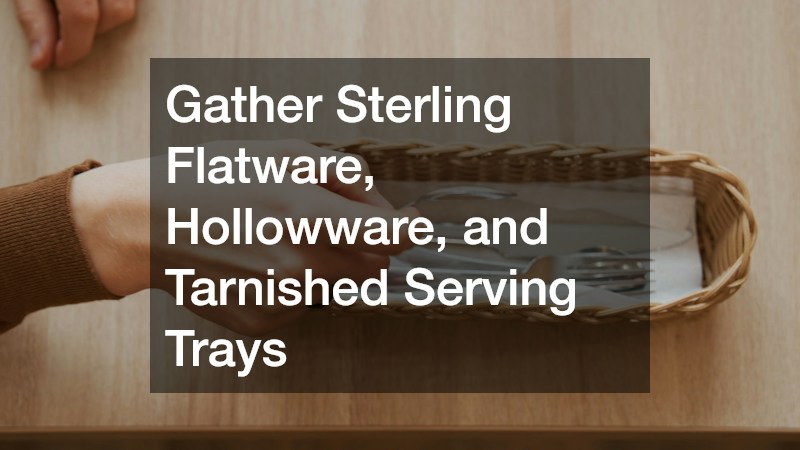
Gather Sterling Flatware, Hollowware, and Tarnished Serving Trays
Dining room sideboards, china cabinets, and inherited storage chests are notorious hiding places for heavy silver items that rarely see the light of day. Because real silver develops a dark, unappealing tarnish over time, many homeowners mistake valuable pieces for junk and toss them into donation bins. With silver trading above $41 per ounce in late 2026, a complete set of sterling flatware or a pair of solid serving bowls can easily fetch several hundred to over a thousand dollars. The critical distinction you need to make before contacting silver buyers is whether your pieces are solid sterling silver or merely silver-plated.
Flip each fork, spoon, candlestick, or tray over and examine the back or underside for stamped hallmarks. Solid sterling items will almost always be stamped with the word “Sterling,” the number “925,” or traditional British lion hallmarks indicating 92.5% pure silver content. By contrast, stamps reading “EPNS” (Electroplated Nickel Silver), “Silverplate,” “IS,” or “Rogers Bros.” indicate a base metal like brass or copper coated in a microscopic layer of silver that holds virtually no melt value. Also check the bases of candlesticks and salt shakers for the word “Weighted,” which means the hollow shell is filled with cement or resin; dealers will estimate the actual silver weight, excluding the filler. Finally, resist the urge to polish your sterling pieces before selling, as abrasive polishes can strip away fine details and reduce numismatic value on antique patterns.
Sort Pre-1965 Pocket Change and Inherited Currency Collections
That heavy glass jar of loose change sitting on your closet floor or the cigar box of old coins tucked into an inherited desk drawer deserves a closer look before you dump it into a grocery store counting machine. Prior to 1965, United States dimes, quarters, half dollars, and dollar coins were minted using 90% silver and 10% copper. Even in heavily worn condition, these “junk silver” coins trade for roughly 28 to 30 times their face value based on their silver content alone, meaning a single pre-1965 quarter is worth over seven dollars. Beyond silver content, certain rare dates, mint marks, and error coins carry collector premiums that far exceed their metal value.
Sorting through a large batch of coins is an easy evening project that requires nothing more than good lighting and a few basic checks. Once you have pulled out potential candidates, schedule an appointment with local coin buyers who can evaluate both bullion weight and collector rarity. Follow these practical guidelines as you sort your stash:
-
Check the edges of dimes, quarters, and halves: Modern clad coins show a distinct copper-colored stripe along the ridged edge, whereas pre-1965 silver coins appear solid silver all the way through.
-
Look for 1965 through 1970 Kennedy half dollars: While most coins switched to copper-nickel in 1965, Kennedy half dollars minted during these years still contain 40% silver.
-
Inspect wheat pennies and Buffalo nickels: Lincoln cents minted before 1959 and nickels minted between 1913 and 1938 can carry collector value, especially if they bear “S” (San Francisco) or “D” (Denver) mint marks.
-
Never clean, scrub, or polish old coins: Even gentle wiping creates microscopic hairline scratches that collectors can spot immediately, often slashing a coin’s numismatic value by 50% or more.
If you uncover old paper banknotes—such as Silver Certificates with blue seals, Red Seal United States Notes, or pre-1928 large-size bills—store them flat inside protective sleeves rather than folding them into your wallet. Taking the time to separate silver coins and vintage paper currency from ordinary spending change ensures you capture every dollar hiding in plain sight.
Pull Vintage Sports Cards and Trading Card Binders Out of Storage
If you collected baseball, basketball, or football cards as a kid—or spent allowance money on Pokémon and Magic: The Gathering booster packs in the 1990s and early 2000s—your childhood hobby may have quietly matured into a serious asset. The trading card market remains remarkably active, driven both by competitive players seeking tournament staples and collectors chasing nostalgic vintage rookies and rare holographic prints. However, not every old binder is a goldmine; cards produced during the “junk wax” era of the late 1980s and early 1990s were printed in massive quantities and often hold minimal value unless they feature Hall of Fame rookies in pristine, gem-mint condition. Knowing how to separate genuine hits from common bulk will save you hours of frustration.
Start by pulling out star players, rookie cards, numbered serial cards, autographs, and holographic or foil treatments. To determine realistic values, search each card on eBay and filter specifically by “Sold Items” rather than looking at inflated active asking prices. Pay close attention to the four corners, surface gloss, edges, and centering of the image, as condition is the single biggest driver of price in the hobby. For high-value single cards, visiting a reputable card shop in your area allows you to get an in-person assessment, sell quickly for cash or store credit, and get honest advice on whether a standout card is worth submitting to a third-party grading company like PSA or SGC.

Catalogue Retro Toys, Comic Books, and Nostalgic Pop-Culture Memorabilia
Nostalgia is one of the most reliable economic forces in the secondhand market, as adults in their thirties, forties, and fifties eagerly buy back the toys, comic books, and video games they loved growing up. Bins of 1980s and 1990s action figures—such as Star Wars, Transformers, Teenage Mutant Ninja Turtles, and G.I. Joe—consistently attract eager buyers, especially if you still have their original weapons, capes, and vehicles. Similarly, long boxes of Bronze and Modern Age comic books, vintage board games with all their pieces, and original Nintendo, Sega, or PlayStation cartridges regularly command strong prices. Even items that seem mundane to you, like vintage band T-shirts, concert posters, or classic Lego sets, can spark bidding wars among dedicated enthusiasts.
Before listing or transporting your items, take an afternoon to organize them by franchise, match loose accessories to the correct figures, and test any battery-operated toys after checking for battery compartment corrosion. If you have a sizable collection and want to avoid the hassle of photographing, packing, and shipping dozens of individual packages, reaching out to a local collectible shop is an efficient way to liquidate an entire lot in a single transaction. Keep in mind that brick-and-mortar dealers typically pay 40% to 60% of retail value to cover their storefront overhead, so if you have a few rare, high-ticket items, selling those individually online while bulk-selling the commons locally gives you the best of both worlds.
List Unused Electronics and Legacy Tech Before Depreciation Hits Zero
Take a quick inventory of your desk drawers and media console, and you will likely find at least two or three old smartphones, an outdated tablet, a digital camera, or an older-generation gaming console. Unlike vintage collectibles, modern consumer electronics lose value every month a newer model hits store shelves, making speed your biggest ally. That said, working smartphones from the last three to four years, Apple Watches, e-readers, graphing calculators, and DSLR lenses retain surprisingly strong resale value because buyers love saving money on refurbished gear. Even broken or cracked phones hold value for repair technicians who harvest OEM screens, cameras, and motherboards for parts.
Before handing over any device, protect your personal data by backing up your photos, signing out of iCloud or Google accounts, removing SIM or SD cards, and executing a full factory reset. Including the original charging cable, power brick, and retail box can easily bump your sale price by $15 to $30 because it signals to buyers that the device was well cared for. If you want guaranteed cash without dealing with buyer messages, trade-in platforms like Gazelle, Back Market, or Best Buy offer instant quotes and prepaid shipping labels. If you want maximum profit, listing cleanly photographed devices on Swappa or Facebook Marketplace typically nets 20% to 30% more than automated buyback programs.
Clear Out High-Demand Kitchen Appliances, Power Tools, and Brand-Name Gear
Some of the highest-dollar items sitting unused in your home are bulky, durable household goods that cost too much to ship profitably—making them ideal for local cash sales. Walk through your kitchen and garage with a critical eye for name-brand workhorses that you rarely use, such as KitchenAid stand mixers, Vitamix blenders, Breville espresso machines, cordless drill sets, circular saws, and pressure washers. High-quality outdoor and fitness gear—including brand-name camping tents, Yeti coolers, adjustable dumbbells, and road bikes—also moves rapidly when priced fairly. Buyers actively search local classifieds for these staples because they know reputable brands are built to last for decades.
Presentation makes an enormous difference when selling functional household equipment and tools. Wipe down grease, dust, and sawdust, descale coffee makers, and verify that all blades, mixing paddles, batteries, and chargers are accounted for before taking photos. Plug the appliance in, or power up the tool on video so skeptical buyers can see that the motor runs smoothly and indicator lights work properly. Listing these items on Thursday evening or Friday morning positions your ad right in front of weekend DIYers, home cooks, and hobbyists who are ready to pick up and pay cash immediately.

Stage, Photograph, and Price Everyday Items for Fast Local Pickup
Having valuable clutter is only half the equation; how you package and present those items determines whether they turn into cash within 48 hours or sit unsold for six months. Many sellers sabotage their own listings by snapping blurry, dimly lit photos on a messy bed and writing three-word descriptions that leave buyers guessing about size, model numbers, or flaws. Taking five extra minutes to stage your items properly builds instant buyer trust and allows you to command higher prices with far fewer back-and-forth questions. When you are ready to post on Facebook Marketplace, Craigslist, or OfferUp, apply these proven selling habits:
-
Shoot in natural daylight against a neutral backdrop: Place items near a bright window or outdoors in open shade on a clean table, wood floor, or solid-colored sheet so colors and textures look accurate.
-
Capture every angle and disclose flaws upfront: Take at least five photos showing the front, back, model/serial tag, included accessories, and any scratches or dents so buyers feel confident committing.
-
Write keyword-rich titles with exact brand and model names: Include dimensions, color, capacity, and condition (e.g., “KitchenAid Artisan 5-Quart Stand Mixer – Empire Red – Works Great”) so your listing appears in specific searches.
-
Build a 15% negotiation buffer into your asking price: Local buyers almost always ask if you will take less, so pricing a $100 item at $115 lets you accept a $100 offer while making the buyer feel like they won a deal.
To keep transactions smooth and safe, state clearly in your description that you accept cash or verified instant payment apps upon pickup, and arrange to meet in a well-lit public location—such as a local police station safe-exchange zone or busy coffee shop parking lot. By treating every listing like a mini storefront, you turn casual browsers into decisive buyers and clear your home faster.
Turning your clutter into cash does not require an entire weekend of backbreaking work or a massive garage sale that leaves you exhausted for minimal return. By tackling one drawer, shelf, or storage bin at a time, you can systematically uncover hidden value in forgotten jewelry, vintage coins, childhood collectibles, idle electronics, and sturdy household gear. Pick a single category from this guide today, gather the items sitting unused in your home, and put that dormant money back where it belongs—working for your financial goals.